


Accueil
>
Actualités sur le nettoyage
>
Maîtriser le dépoussiérage en hauteur dans le secteur commercial : Techniques essentielles pour un lieu de travail impeccable

Maîtriser le dépoussiérage en hauteur dans le secteur commercial : Techniques essentielles pour un lieu de travail impeccable
Nous savons tous que la poussière semble apparaître comme par magie, surtout dans les recoins difficiles d'accès de nos lieux de travail. Outre son aspect inesthétique, elle peut impacter la qualité de l'air que nous respirons et même présenter des risques pour la sécurité. C'est là qu'intervient le dépoussiérage en hauteur. Nous allons voir pourquoi il est si important et comment y remédier efficacement pour que nos installations restent impeccables et fonctionnent sans accroc.
Points clés à retenir
- La poussière et les squames animales s'accumulent naturellement en hauteur, dans des endroits difficiles d'accès comme les plafonds, les poutres et les conduits de ventilation, ce qui nuit à la qualité de l'air et peut engendrer des risques d'incendie. Un dépoussiérage régulier en hauteur est essentiel pour maintenir un environnement sain et sécuritaire.
- L'utilisation des outils appropriés, tels que des perches extensibles légères et des accessoires spécialisés, rend le dépoussiérage en hauteur commercial plus sûr et plus efficace, éliminant souvent le besoin d'échelles ou de nacelles élévatrices.
- L'intégration du dépoussiérage commercial en hauteur dans notre routine de nettoyage globale, et la prise en compte des risques spécifiques comme les poussières combustibles, nous aident à obtenir un lieu de travail toujours impeccable et sécurisé.
Comprendre l'importance du dépoussiérage en hauteur commercial
On sait tous que la poussière et les squames animales peuvent se déposer partout, mais avez-vous déjà remarqué la quantité qui s'accumule dans les endroits difficiles d'accès ? On parle du dessus des placards, des poutres du plafond, des luminaires et des conduits de ventilation. Ces zones sont souvent négligées lors du nettoyage régulier, et pourtant, elles deviennent de véritables nids à poussière et à particules en suspension.
Pourquoi la poussière et les squames s'accumulent-elles en hauteur ?
Pensez à la circulation de l'air dans un bâtiment. Les systèmes de chauffage et de climatisation, le passage quotidien et même l'ouverture des portes peuvent soulever de fines particules. Très légères, ces particules s'élèvent naturellement. Avec le temps, elles se déposent sur les rebords, les tuyaux et les surfaces supérieures du bâtiment. Il ne s'agit pas seulement d'un problème esthétique ; cette accumulation peut affecter la qualité de l'air que nous respirons et même présenter des risques pour la sécurité.
- Qualité de l'air : La poussière accumulée peut contenir des allergènes, des spores de moisissures et d'autres irritants. Lorsqu'elles sont remises en suspension, ces particules peuvent provoquer des allergies ou des problèmes respiratoires chez les occupants.
- Risques d'incendie : Dans certains environnements, comme les cuisines ou les zones de production, l'accumulation de poussière à proximité des sources de chaleur ou des équipements électriques peut constituer un risque d'incendie.
- Esthétique : La poussière visible en hauteur peut nuire à l'aspect général d'un espace professionnel, donnant une impression de propreté négligée aux clients ou aux visiteurs.
On oublie facilement les zones situées au-dessus de nos têtes, pourtant elles jouent un rôle important dans la propreté et la salubrité de notre environnement de travail. Un entretien régulier de ces zones en hauteur est essentiel.
Le rôle crucial du dépoussiérage en hauteur dans la maintenance des installations
Le dépoussiérage en hauteur est bien plus qu'un simple coup d'éponge ; c'est un procédé de nettoyage spécialisé qui permet d'atteindre ces zones en hauteur. L'utilisation d'outils adaptés, comme des perches télescopiques et des brosses ou aspirateurs spécifiques, nous permet d'éliminer efficacement et en toute sécurité la poussière accumulée, sans avoir recours à des échelles ou des nacelles élévatrices. Ceci améliore non seulement la qualité de l'air et la sécurité du bâtiment, mais contribue également à créer une atmosphère plus professionnelle et accueillante. C'est un élément essentiel d'un plan de maintenance préventive qui garantit l'esthétique et le bon fonctionnement de nos installations.
Techniques essentielles pour un dépoussiérage en hauteur efficace en milieu commercial
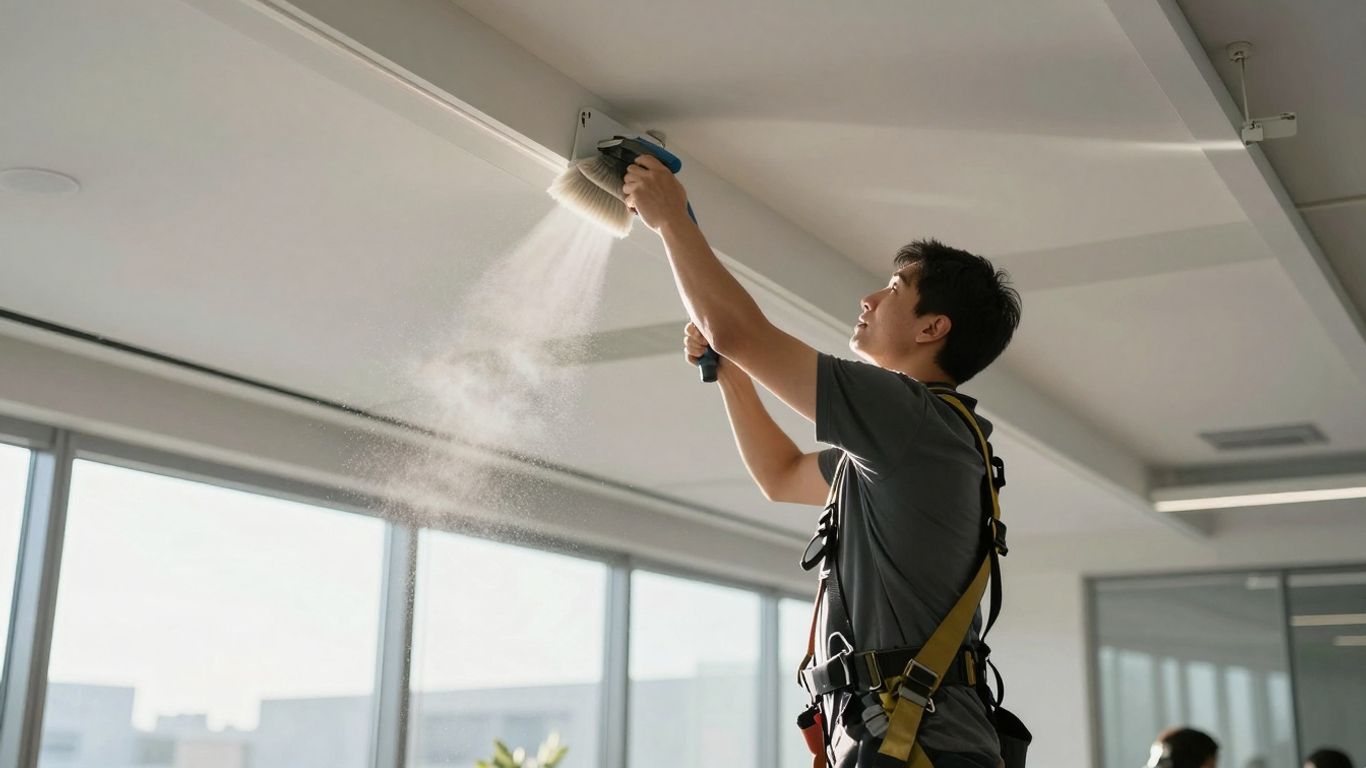
Lorsqu'on parle de dépoussiérage en hauteur à des fins commerciales, on cherche avant tout à nettoyer les endroits difficiles d'accès sans difficulté ni danger. Il s'agit d'utiliser l'équipement adéquat et de maîtriser les techniques de nettoyage. Notre objectif est de garantir un nettoyage sûr et efficace.
Choisir les bons outils pour le nettoyage en hauteur
Choisir le bon équipement est la première étape pour un dépoussiérage efficace en hauteur. Nous avons constaté que l'utilisation d'outils spécialisés fait toute la différence. Il ne s'agit pas simplement d'avoir une longue perche ; il faut une perche légère, robuste et compatible avec différents embouts de nettoyage.
- Perches télescopiques : Idéales car elles s’étendent à la hauteur exacte souhaitée, généralement jusqu’à 12 mètres. Privilégiez les perches en fibre de carbone ; leur légèreté est un atout précieux pour les travaux en hauteur prolongés. Clean Direct propose des perches de ce type, conçues pour un usage professionnel.
- Têtes de nettoyage : Différents accessoires sont nécessaires selon les tâches. Nous utilisons :
- Brosses statiques pour le dépoussiérage à sec, permettant d'attraper la poussière et les toiles d'araignée.
- Des manchons en microfibre lavables, idéaux pour les surfaces délicates.
- Des têtes d'aspirateur qui se connectent à nos systèmes pour capturer la poussière pendant le nettoyage, ce qui contribue grandement à améliorer la qualité de l'air.
- Systèmes d'aspiration : Pour les travaux très poussiéreux, notamment lorsque la poussière représente un danger, un bon système d'aspiration est indispensable. Les systèmes SkyVac, par exemple, sont conçus pour être utilisés avec ces perches et sont équipés de filtres HEPA pour retenir les particules fines.
Mise en œuvre de procédures de dépoussiérage en hauteur sûres et efficaces
Une fois nos outils en main, tout repose sur la méthode. La sécurité est primordiale, surtout lors de travaux en hauteur, même avec des perches. L'efficacité découle de la maîtrise des techniques de déplacement et de nettoyage.
- Travaillez de haut en bas : commencez toujours par le point le plus haut et descendez progressivement. Ainsi, la poussière et les débris qui tombent se déposent sur une zone non encore nettoyée, ce qui vous évite de devoir nettoyer à nouveau.
- Gardez l'équilibre : même avec des bâtons, assurez-vous d'avoir une position stable. Évitez de trop vous étirer, ce qui pourrait vous faire perdre l'équilibre.
- Utilisez l'aspirateur lorsque c'est possible : dans les zones très poussiéreuses ou présentant un risque d'incendie, l'utilisation d'un embout d'aspirateur est la meilleure solution. Il capture la poussière instantanément.
- Entretien régulier des outils : Nettoyez vos brosses et manchons en microfibre après chaque utilisation. Vérifiez que les manches ne sont pas endommagés. Cela permet à vos outils de fonctionner correctement et prévient les accidents.
Nous avons constaté qu'un minimum d'organisation est essentiel. Savoir quel outil utiliser pour quelle surface et suivre une méthode de nettoyage rigoureuse nous permet de réaliser un travail impeccable à chaque fois, sans nous mettre en danger ni mettre les autres en danger. Il s'agit d'adopter une approche intelligente.
Considérations avancées pour le dépoussiérage en hauteur à des fins commerciales
Gestion des risques liés aux poussières combustibles
Il est essentiel d'aborder la question des poussières combustibles. Elles représentent un véritable danger dans de nombreux endroits, notamment là où des particules fines comme du bois, du métal ou même des poudres alimentaires peuvent s'accumuler. Ces particules, en suspension dans l'air et à proximité d'une source d'inflammation, peuvent provoquer de graves incendies ou explosions. Pensez aux poutres de plafond, aux conduits de ventilation et aux luminaires : des endroits souvent difficiles d'accès qui peuvent devenir des foyers d'accumulation de ces poussières dangereuses. Un nettoyage régulier et minutieux est la meilleure façon de garantir la sécurité de ces zones. L'utilisation d'équipements adaptés, comme nos perches de dépoussiérage en hauteur associées à des aspirateurs à filtre HEPA, nous permet d'éliminer ces poussières sans les disperser dans l'air. Il s'agit d'être proactif et de bien comprendre les risques afin de protéger les personnes et les biens.
Les poussières combustibles représentent un grave danger pour la sécurité dans de nombreux environnements industriels et commerciaux. Les fines particules de poussière provenant de matériaux tels que le bois, les métaux, les plastiques, les produits alimentaires et les textiles peuvent s'accumuler sur les surfaces, notamment dans les zones en hauteur difficiles d'accès, et présenter des risques d'incendie ou d'explosion lorsqu'elles sont en suspension dans l'air et exposées à des sources d'inflammation.
Intégrer le dépoussiérage en hauteur dans un plan de nettoyage complet
Le dépoussiérage en hauteur ne doit pas être une tâche ponctuelle ; il doit faire partie intégrante de notre routine de nettoyage régulière. Sa planification doit être adaptée aux besoins spécifiques de chaque établissement. Dans certains cas, un dépoussiérage mensuel peut suffire, tandis que dans d’autres, comme les usines ou les lieux à forte activité, il peut être nécessaire de le faire toutes les deux semaines. Lors de la planification du nettoyage, il convient de prendre en compte les éléments suivants :
- Fréquence : À quelle fréquence cette zone précise nécessite-t-elle une attention particulière ? Tenez compte de l’environnement et du risque d’accumulation de poussière.
- Outils : De quel équipement avons-nous besoin ? Utiliser les bonnes perches, brosses et aspirateurs de marques comme Clean Direct rend le travail plus sûr et plus efficace.
- Moment opportun : Quel est le meilleur moment pour effectuer ces travaux ? Souvent, il est préférable de les réaliser en dehors des heures de travail afin d’éviter de perturber les opérations quotidiennes ou de contaminer les zones de travail situées en dessous.
En intégrant le dépoussiérage en hauteur à notre stratégie de nettoyage, nous contribuons à une meilleure qualité de l'air, à la réduction des risques pour la sécurité et à la propreté impeccable de l'ensemble des locaux. L'objectif est d'adopter une approche cohérente pour un environnement de travail plus propre et plus sûr.
Pour les tâches exigeantes comme le nettoyage des zones en hauteur dans les espaces commerciaux, il ne suffit pas d'atteindre le sommet. Notre section « Considérations avancées pour le dépoussiérage en hauteur dans les locaux commerciaux » détaille les points essentiels à connaître. Nous y abordons les consignes de sécurité, les outils adaptés et les méthodes pour un travail efficace. Vous souhaitez en savoir plus sur la propreté impeccable de vos locaux ? Consultez notre site web dès aujourd'hui pour obtenir des conseils d'experts et des solutions !
Conclusion de notre voyage de dépoussiérage en haute altitude
Nous avons donc abordé de nombreux points concernant le nettoyage des zones difficiles d'accès. Il est clair que le maintien de la propreté des espaces commerciaux ne se limite pas à ce que l'on voit à hauteur des yeux. En utilisant les outils et les techniques appropriés pour le dépoussiérage en hauteur, nous pouvons réellement améliorer la qualité de l'air, la sécurité et l'image professionnelle des lieux. Nous espérons que ce guide vous a donné l'assurance et le savoir-faire nécessaires pour réaliser ces tâches efficacement. N'oubliez pas : un petit effort supplémentaire en hauteur peut contribuer à un environnement bien meilleur pour tous.
Partager


